
Thursday, November 27, 2014
Friday, October 24, 2014
Gregorich's Guide to Writing Mysteries

Gregorich guides the reader through potential challenges of creating suspense--from naming characters to detailing the scene of the crime, from dialogue to denouement.
This brand new volume is available in print and Kindle versions. Gregorich, a former journalist and a veteran writer, narrates with a no-nonsense style that lures the reader in from page one, on which she praises setting as the backbone of a good mystery (a sentiment she shares with the great P.D. James).
Find out more about this mystery guide HERE.
Thursday, October 09, 2014
A Craig Johnson Treat

I was super excited to get this petite volume in the mail--a book of short stories by the great Craig Johnson, the creator of the Walt Longmire mystery series.
Angela at Viking/Penguin filled in the interesting background of this compilation:
"Ten years ago, Craig Johnson wrote his first short story, the Hillerman Award-winning Old Indian Trick. This was one of the earliest appearances of the sheriff who would go on to star in Johnson’s bestselling, award-winning Walt Longmire novels and the hit TV drama series Longmire. Each Christmas Eve thereafter, Johnson has sent to friends a new short story featuring an episode in Walt’s life that doesn’t appear in the full-length novels. WAIT FOR SIGNS is the first time these stories are available in a single volume and also features an entirely new story, Petunia, Bandit Queen of the Bighorns."
I love Johnson's writing, and have talked about it in various blog posts that you can read here, here, and here. In the last link I compare Johnson's writing to that of one of my other favorite writers, Ross MacDonald, who paved the way for writers like Johnson with his moody Lew Archer mysteries.
It will be nice to be able to enjoy some of Johnson's fiction in smaller, more easily digestible pieces (for the reader on the go!)
The book goes on sale officially on October 21st!
Sunday, July 20, 2014
Remembering James Garner and The Rockford Files
"This is Jim Rockford; at the tone, leave your name and message. I'll get back to you." So goes the famous answering machine message one heard at the beginning of every episode of THE ROCKFORD FILES, and which you can still hear on The Rockford Files Website.
The great James Garner has died, but his memory lives on in all of his great work (I'm reminded of the way he held his own onscreen with an equally charismatic Doris Day). Recently there was talk of remaking THE ROCKFORD FILES, which was Garner's best television work. I'm not sure what became of the remake, but with the loss of Garner, one might want to reminisce about the greatness of the original series, and there are plenty of Rockford fans online who are keeping Garner's Rockford alive and well. There's a tribute to the show here, with all sorts of memorabilia, photos and links.
Then, for true Garner lovers, there's James Garner online. I had forgotten what a truly attractive and charismatic man Garner was until I wandered through these tribute sites.
Garner and his show are forever memorialized on the Museum of Broadcast Communications.
Recently, according to "Tribute" site, P.I. Magazine awarded Garner with their first ever "Outstanding Achievement" Award as "Television's Most Famous Private Investigator." A more fitting tribute I cannot imagine, and a wonderful picture of Garner and his award accompany that story.
I doubt I'll watch the new version of THE ROCKFORD FILES. It's a show there's just no reason to re-make--not while Netflix still offers the Garner originals. I can't imagine anyone capturing that rare charisma that Garner gave to his character, nor can I imagine the show having the same success.
The great James Garner has died, but his memory lives on in all of his great work (I'm reminded of the way he held his own onscreen with an equally charismatic Doris Day). Recently there was talk of remaking THE ROCKFORD FILES, which was Garner's best television work. I'm not sure what became of the remake, but with the loss of Garner, one might want to reminisce about the greatness of the original series, and there are plenty of Rockford fans online who are keeping Garner's Rockford alive and well. There's a tribute to the show here, with all sorts of memorabilia, photos and links.
Then, for true Garner lovers, there's James Garner online. I had forgotten what a truly attractive and charismatic man Garner was until I wandered through these tribute sites.
Garner and his show are forever memorialized on the Museum of Broadcast Communications.
Recently, according to "Tribute" site, P.I. Magazine awarded Garner with their first ever "Outstanding Achievement" Award as "Television's Most Famous Private Investigator." A more fitting tribute I cannot imagine, and a wonderful picture of Garner and his award accompany that story.
I doubt I'll watch the new version of THE ROCKFORD FILES. It's a show there's just no reason to re-make--not while Netflix still offers the Garner originals. I can't imagine anyone capturing that rare charisma that Garner gave to his character, nor can I imagine the show having the same success.
Friday, June 27, 2014
Exciting Summer Reading!

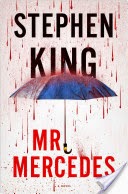 I was lucky enough to get a package from Scribner today with two amazing books inside. First, the latest Richard Jury novel from Martha Grimes. I have been a huge Grimes fan since my mother-in-law handed me THE OLD SILENT in the early 90s and asked if I'd like to read it. I knew nothing of Grimes then, but I read a few chapters and was hooked--and I've loved Jury and Melrose Plant and Aunt Agatha ever since.
 Naturally, then, I'm very excited to read VERTIGO 42, in which Richard Jury investigates a death long past, yet not forgotten.
Added to this bounty is MR. MERCEDES, the new and much-lauded Stephen King novel.
How can I lose with this sort of talent offering new doses of suspense and adventure? Thank you, Scribner, for my latest summer reading.
Wednesday, May 28, 2014
A Tribute to the Great Mary Stewart

I grew up reading Stewart's suspense fiction, along with her inspiring Arthurian trilogy. When I became a writer, I thanked Stewart in my acknowledgements for being the primary influence in my decision to choose the mystery genre.
Now she has left us, but her body of work remains, and it is the work that deserves credit--and a renaissance.
Mary Stewart wrote her first suspense novel in 1953. Her immediate success (which never lessened in intensity) was due to the whims of fate. A classics professor at Durham University, Stewart intended to devote her life to teaching and the family she planned to start with her new husband--a family that never materialized. "I don't suppose I'd have written books if I'd had [children]," Stewart confessed in a rare interview. A writer for the Glasgow Herald identifies the kairos of Stewart's literary career: "Out of her personal heartbreak came our pleasure" (Herald 2). But Stewart's window of opportunity opened not only because of her altered life path; she lived at a time when her genre needed updating. With her first book, Madam, Will You Talk, Stewart created a new kind of romantic suspense novel that still paid homage to the Gothic style of her forbears, notably the Bronte sisters and, later, Daphne du Maurier. In fact, Stewart's fiction, initially sort of a bridge between old Gothic and the new suspense, ultimately formed its own genre.
Because of this background and because of her unique talent, Mary Stewart was arguably one of the most influential suspense novelists of the mid-twentieth century; the reasons for her success are many, and require a deconstruction of literature that some would call "dated," as well as an examination of Stewart's literary style, which creates a new sort of discourse for the suspense reader. First, though, one must look at Stewart's powerful depictions of setting. As in some other romantic suspense novels, Stewart's locations are generally far-flung and full of history; in this way she creates an important avenue for suspense: initially, the narrative removes the heroine from her "safe" existence; secondly, it provides the readers with an escape from their own realities and a pathway into the beauty--and danger--of the new locale; finally, they echo the literary style because they are imbued with the history of literature itself.
Innate to her discussions of setting are her literary allusions; in fact, she creates a new literary intertextual style which connects the Gothic suspense novel (and the Gothic woman) with a more modern sensibility; she sustains this with recurring literary and artistic intertextual references, with mimetic echoes of famous literary works (for example, the parallels to The Tempest in Stewart's This Rough Magic). She creates a world in which the literary being reigns, and in which characters might complete one another's Shakespearean quotations. The fact that this world is utterly believable is a part of what many critics call Stewart's "magic" as a writer.
It can be further argued that her heroines establish a new feminist ideal, evident in the first-person discourse of her characters while they navigate anti-traditional, anti-cultural settings that allow them to act against type, which suggests an ironic examination of gender roles.
All of the staples of romantic suspense can be found in Stewart's suspense novels: beautiful settings, adventurous heroines, and a brooding mystery. Stewart, however, takes those basic elements and embellishes them enough to create a new genre: the literary romantic suspense novel. By marrying history and setting, she allows her reader to feel both intelligent and invested in place.
Swanson and James suggest that "Many later writers in the field have been influenced by Stewart's style and popularity, including Caroline Llewellyn, D.F. Mills, Phyllis A. Whitney, Victoria Holt, Elizabeth Peters, and Dorothy Cannell" (Swanson and James 216-217).
Stewart herself contended that a good story "should be carried alive into the heart of the reader, and this is only done by the writer's passion disciplined by the writer's skill" (Setting and Background 9)
Both Stewart's passion and her skill have made her a household name for lovers of mystery and suspense for more than sixty years. In reflecting on her own ability as a storyteller, Stewart dismisses any special credit: "I couldn't help it," she writes, adding that her own reason for writing, even from early childhood, was "to open the door to my own wonderland" (Teller of Tales 10).
Stewart's readers can be ever grateful that, in publishing her successful books, she opened that door to us all.
© Julia Buckley 2014 (excerpted from a longer work by Julia Buckley).
Works Cited
“My Secret Best
Friend: Mary Stewart.” The Herald 23 July 2004: n. pag. NewsBank
Academic Library Edition. Web. 24 Sept. 2009.
Stewart, Mary. “Setting
and Background in the Novel.” The Writer 1964: 7-9. Print.
Swanson, Jean, and Dean James. “Mary Stewart.” By
A Woman’s Hand. New York : Berkley
Thompson, Raymond H. “Interview with
Mary Stewart.” Raymond H. Thompson’s Interviews with Arthurian Authors.
The Camelot Project, 18 Sept. 2009. Web. 26 Sept. 2009.
.
Saturday, April 26, 2014
SYNDROME E Now Out in Paperback
In light of the paperback release of SYNDROME E, I a book I greatly enjoyed, I thought I'd re-run the interview I did with its author, Frank Thilliez, last year.


Franck Thilliez's new novel, SYNDROME E, is his first book available in an American translation. The movie rights have been sold to Paintbrush Films.
Franck, thanks so much for discussing your book with me.
This novel introduced many themes: neuroscience, police work, schizophrenia, parent-child relationships, a computer-oriented world, violent video games, film technology, and subliminal suggestion, to name a few. Do you start a novel knowing all the themes you would like to discuss, or does your research and writing lead you to more and more complicated plots?
Yes, I know, in a general way, the main topics I’ll talk about. Concerning Syndrome E, I wanted to talk about all themes concerning pictures and the impact they have on our brain. So, it concerned movies, video games, subliminal pictures, brain studies… But you’re right: the more I researched, the more I discovered plots that I could talk about, like neuromarketing or the way a movie is made. So, I naturally included them in my story.
Lucie Hennebelle is a single mother of twins; she is also a career cop. This sounds like an almost impossible combination. Do you think that cops, male and female, spend a lot of time feeling guilty about their family obligations?
I know a few cops and I often talk with them about their job. They are people really involved in their work, they like what they’re doing and are proud of it. When you work in the violent crime department, here in France, you can’t say: “I go to work at 8 am and come back home at 5 pm,” because it does not depend on you, but on murderers! If you work on a big case, it will take all your time, day and night, because, you know, the 2 or 3 first days after a crime is committed are the most important: you can’t lose a minute. So, you’ll not be at home, near your family, and your work will consume you. But, most of time, they do not feel guilty, because this job is a part of their life, as much important as their children. It’s not easy to be the wife of a cop (or the husband of a female cop), because, adding to that, this could be a dangerous job…
Someone in the novel suffers from hysterical blindness. I’d heard the term before, but had never really seen it applied to a situation. How common is this condition? How did you research it?
It’s an amazing condition. I heard about it when I talked with a psychiatrist. He said to me: “One day, I treated a woman who did not hear her husband when he talked to her. She heard her children, but she couldn’t hear him! This is what we call hysterical deafness. She’s not really deaf, but her brain makes her believe she is… ” It was amazing. By doing research, I discovered that there were all sorts of such hysterical problems: people thinking they’ve lost a leg or arm, people thinking they’re blind… All those conditions have a psychological explanation and can be solved.
Franck Sharko is a great name for a detective. Did he become Sharko because he is predatory to the bad guys? Or did you have other reasons for giving him this name? (And is there a reason that you share a Christian name?)
Here, in France, most readers ask me : “Why did you call your detective Sharko ?” It’s great that you are American, because you immediately see that in Sharko, there is the English word “Shark." Shark, because Franck Sharko never abandons, he’s really a hunter of killers and will work and work until he catches them! And for the first name, Franck, the same as mine: I just wanted “Franck Sharko” to sound hard, like German. Because he’s a hard guy!
One of the many facts that stood out for me was a film expert’s claim that François Mitterand attempted, in 1988, to subliminally influence voters by splicing his image into the credits of the evening news. How did he achieve this? Did he pay off a producer?
In France, the “Chanel 2” is a public channel, so it belongs to the French State. A president can choose the head of the channel, and he can decide to squelch publicity, … I don’t know how it really happened with François Mitterand, but because he was president since 1980 he had the power to put a subliminal image of himself on the evening news a few weeks before the election of 1988 to re-elect him! You must also know that during this period, there were no laws that forbade someone to use subliminal images in films or advertising…
Wow! How worried should we be, in 2012, that we are being manipulated through the medium of film or things that we see on computer and television screens?
As I say in the book, we must protect our children, who are always watching violent pictures, in video games, on Internet or television. Most of them (under 7 years old) can’t distinguish reality from fiction. With the new technologies (phones, i-pads, Internet), times are changing; now our sons and daughters are growing up with violent pictures around them.
In extreme cases, we can perhaps see the consequence of this in the news: look what happened in Norway with Behring Breivik, look at the different massacres in schools over the last years, or the awful killing in the cinema during the broadcast of Batman, a few days ago. Some killers even try to post their acts on the Internet.
So, I don’t think we are manipulated, I just want to tell people: be careful of all those screen broadcasted pictures; they could be dangerous…
Are you an old film buff yourself? Do you collect films?
When I was 15 years old, and for many years later, I used to watch all horror/thriller/suspense films that would be broadcast on TV! Sometimes, films were broadcast late in the night, and I remember going to bed and setting my alarm clock to wake me up just before the beginning of the film. It was also the period I was a member of a small video club, near my house, so I could rent of all the tapes I wanted. I used to collect video tapes, and then DVDs, but I sold most of them when I grew up, because I needed money! I always loved Hitchcock’s films, Dario Argento, Andrew Romero, David Cronenberg; and nowadays, David Fincher, Christopher Nolan or Ridley Scott are some of my favorite directors.
You must have loved Inception. :)
Your description of Egypt, through Sharko’s eyes, is not flattering—it talked me out of ever visiting Egypt. Have you travelled there?
Talking about the Egypt in tour guides with the Pyramids, Sphinx, nice places in Cairo was not interesting me. A crime novel must be more than a diversion; it must inform readers of the reality of our world. So, I wanted to show the country as it really is. Most of people there are poor; they have difficulties surviving and they live in awful conditions. There are more than 8 shantytowns at the border of the Cairo, containing thousands and thousands of people. I say in the book that the police and government are corrupt. Revolution exploded in Egypt only a few months after the publication of Syndrome E in France, and I proves that I was not completely wrong…
And no, I never travelled there, but did a lot of research on this country, watching Egyptian films, reading books, talking by email with people there.
A small story : I tried to be in contact with the police there, just to ask single things, like “how are you clothed?” or “what are the grades in your police?,” but they never answered, they said top secret!
At one point Lily and Sharko feast on Kentucky Fried Chicken. Is this American chain popular in France?
It’s starting to gain popularity, but it’s not as popular as McDonalds!

Ah, the ubiquitous McDonalds! :)
There are many airplane journeys in the novel—Sharko finds them wearying, almost existential experiences—and yet they retain a certain glamour for the reader, linking the characters to far-flung locales. What’s your attitude toward airplane travel? Do you enjoy it?
In the last two years, I travelled a lot because of the publication of my books in many countries. I really like airplane travel. I love being in an airport, seeing people going abroad, and others coming back home. An airport is a particular place where you can touch the world. I read a lot during my travels, and sometimes I write. The most difficult is, of course, the jet lag, but it’s such a good thing to discover new countries and people.
Great point! On to Lucie Henebelle. Lucie is compared, by one character, to Jodie Foster. Are you a Jodie Foster fan? Did you see Lucie Henebelle as sort of similar to Foster’s Clarice Starling? Or do you just like Foster’s combination of toughness and femininity?
I’m absolutely a fan of Jodie Foster! She’s a great actor and she would be perfect for Lucie, the main character of my book, if she were slightly younger. When I created Lucie a few years ago, I had in mind Jodie Foster as she was in The Silence of the Lambs, one of my favorite films.
Who are your literary influences? What are you reading now?
I started by reading Agatha Christie, Arthur Conan Doyle, and classical Anglo-Saxon crime novels. Then I had my period of Stephen King (and still do). He’s a great writer. I spent night after night reading his books, trying to guess how he could frighten us so much. During my studies, I did not read a lot (but was watching films!). I started reading crime novels again 10 years ago. Nowadays, I read Dennis Lehane, Michael Connelly, but also books by John Steinbeck.
If I could make only one journey to France, where should I be sure to go?
Everywhere ! France is a beautiful country, with many cultures, great landscape, big towns but also very quaint villages, where the time has stood still. French food and wine are excellent; just spend time in a little restaurant of Paris or by the sea at Deauville or Cannes!
Sounds lovely! Thank you so much for a terrific read and for answering these questions.
You’re welcome. It was a pleasure.

Tuesday, April 15, 2014
A Wonderful Re-Issue of TIME AND AGAIN
 I am thrilled to see this re-issue of TIME AND AGAIN, Jack Finney's terrific 1970 time-travel novel in which a New York artist travels to the city in 1882. My friend Jim lent me the book in the 1990s and said that I would enjoy it. I did like
the story, which is adventurous, romantic, and nostalgic. But beyond that, the tale had that ineffable something that made me never forget it--neither the title nor the author--and I've recommended it to many people myself in the years since I first read it.
Now Touchstone has released an updated version with "digitally restored art, a completely redesigned interior, and an all-new foreword by Audrey Niffenegger."
I was lucky enough to snag a copy of the new version, and I'm enjoying it greatly, especially the photographs of New York which Finney uses as the basis of his story. Every old photograph creates a sense of nostalgia for a time we never knew, and there is a certain associated sadness with the necessary separation of our reality and that image. Finney erases the separation with his bold tale of a man who walks into the past.
Sunday, April 06, 2014
Giving New Life to Great Fiction

As they say on the website:
"We started with two of the best—Jim Thompson and David Goodis. We hope you will join us as we add more authors such as Charles Williams, Ed McBain, Peter Rabe and many others to our roster. If you recognize the importance of Black Lizard Books, a company that is no longer publishing, in republishing these authors, then you will understand what we hope to accomplish."
I'm always for the idea of re-discovering great writing that has potentially fallen by the wayside. Let's hope Chalk Line is able to build a new readership for authors who deserve it.
And Chalk Line? How about some great mysteries by women? You can start with Margaret Millar and Patricia Wentworth.
Sunday, February 16, 2014
Two Great Reads Culled From The TBR Pile

First, Chris Abani's The Secret History of Las Vegas. I'm surprised I haven't heard of Abani before; his style is literary and accomplished, and he wrote five books before this one, in addition to volumes of poetry. The book reads less like a mystery and more like a novel, but it's a compelling book with Steinbeck-like dialogue and fascinating internal monologues.
His characters, too, are distinctive. First, there is Salazar the detective, who hopes to pin some unsolved murders on a pair of conjoined twins. He enlists the help of Sunil Singh, a South African immigrant who is haunted by the Apartheid years and his own distinct memories. Singh is well-versed in the behavior of psychopaths, and is expected to diagnose the twins as such.
Most memorable, though, are the conjoined twins, named Fire and Water. Their very existence raises questions about the culpability of government and society when children are born with anomalies related to their environment. Fire and Water have been considered freaks all of their lives, but this gives them a distinct view of the world, and of the people who view them with immediate judgment.
Abani's writing, literary and graceful, immerses the reader in his Las Vegas setting--a perfect place to encompass the variations of humanity that pass through this paradoxical city.
Another great read is Elisabeth Elo's North of Boston. In it, she introduces a nuanced, spunky narrator named Pirio Kasparov, an independent woman who recognizes her dualities, smiling wryly at her shortcomings even as she accomplishes feats of valor and detection.

Pirio loses a friend to a boating accident in Boston, but she soon becomes convinced that his death was not accidental, and she begins to look into it. Like Abani, Elo writes seamless prose, poetic and compelling, and her dialogue is memorable, especially when Pirio is talking with her godson, a vulnerable boy who has faced more than his share of conflict.
Pirio is both tragic and funny, and I was worried about her for almost the whole novel, despite the fact that she is very strong and has been scientifically proven to be able to withstand extremes better than just about anyone. Still, she is almost foolishly brave, and my only complaint about the novel is that sometimes Pirio got into situations that I couldn't believe anyone--even she--would be willing to endure.
Both books were a pleasure to read, and I look forward to more from these accomplished authors.
Tuesday, January 28, 2014
"Ice is Just as Great, and Would Suffice"

Frost seemed to predict the climate change debate when he wrote "Fire and Ice." Certainly this winter is making the ice theory seem plausible, except that those with an imagination (and a memory) will recall that the summer temperatures were just as extreme in the other direction, and are likely to be again, accompanied by storms of record intensity. This is the new age of weather.
I just sat holed up for two "snow days" which were really "negative temperatures days." I got to read books and write them, and I was lucky enough to be able to do it in a heated house. I found myself wondering how people (and animals) survive in this brutal weather.
But here are the things that I am most grateful for, after this last weekend in Chicago:
--flannel sheets
--a warm body next to me in bed (my husband)
--goosedown comforters
--safe space heaters
--our working furnace
--emergency workers who help people trapped in the cold
--tea and hot chocolate
--Carmex and Chapstick
--pets who found cozy corners to keep them warm (in the case of our tiny female cat, that place is right in front of the bathroom heat vent--warmest room in the house!)
Keep warm, everyone. This too shall pass.
Tuesday, November 26, 2013
Making the Holiday Reading List
 I'm not normally a reader of historical mysteries, but CITY OF LOST DREAMS, the new book by Magnus Flyte, seems to be much more than that--it is whimsey and fantasy in a historical setting, according to Kirkus, who called it "a lively, amusing romantic mystery," while CNN dubbed it "one of the most original novels released this year."
You had me at romantic, actually, but I always like to read something fresh and lively, and this book seems to be just the ticket for my holiday reading.
There is, apparently, a first book, called CITY OF DARK MAGIC, but I think I'm going to start with number two and see if it strikes my fancy. I can always go back and read the other book by the mysterious Mr. Flyte.
Monday, September 16, 2013
Gearing up for Autumn

Fall is almost here, and the weather in Chicago is aready crisp and cool. This is the time for long walks, hot soup, sweatshirts, and extra covers on the bed--with the windows open!!
What's your favorite thing about autumn?
Monday, September 02, 2013

Monday, July 29, 2013
Barbara Rogan on Writers, Agents, Editors, and Her New Mystery

Let’s begin with the title: it’s a clever one, referring both to the publishing business, in which the main character works, and the heroine’s tendency to embellish her history. What came to you first: the title, or the plot?
I'm glad you enjoyed the book. I agree, it is a very apt title; but as usual with my books, I didn’t come up with it. It was the brainchild of my editor at Viking. While I was writing the book, I was calling it “Can You Hear Me Now?” which I quite liked; but “A Dangerous Fiction” really nailed the novel and I loved it as soon as I heard it.
Your main character, Jo, is tough, yet vulnerable, and she goes through a lot in this novel, both personally and professionally. Is she utterly fictional, or is she an amalgam of agents you have known?
The book offers us an inside look at a successful literary agency and some of the work that is done inside. I was shocked by the uncertainty of it: the fear of colleagues who might bear grudges, of media that might affect the agency’s reputation, of clients that might leave, seeking greener pastures. Is agenting, indeed, not for the faint of heart?
Publishing in general is not for the faint of heart, whether you’re an editor, agent, or writer. When I first started my agency, there were times that I had to worry about putting food on the table. But most people who work in that field do it because they love books and writing, and both agents and editors take great pride in their writers' work.
The cop in the novel, NYPD Detective Tommy Cullen, is an attractive man. He reminded me of Joseph Cotton’s character in Dial M for Murder. Do you happen to like that Hitchcock flick?
I do, though I haven’t seen it in ages. In the back of my mind, though, as I wrote A DANGEROUS FICTION, I was hearing dialogue from those classic Thin Man movies and Dorothy Parker’s stories.
Cool!! Jo’s past is littered with memories she doesn’t want to confront: the deaths of her parents; the abuses perpetrated by her grandmother; the marriage she insists was perfect. Why would someone as brilliant as Jo be so limited in analyzing her own experience?
Because it worked for her to compartmentalize her life, instead of integrating all its disparate parts. That integration is part of the journey she’s on, and one of the reasons I feel compelled to write more about Jo. But don’t we all tweak bits of our lives to make it a better story? Fiction is so much tidier than real life: more reason, less chance.
 I was particularly fond of a character named Mingus, who happened to be a dog. Is Mingus based on any German Shepherds you have known?
All of them. So glad you liked Mingus! A good German shepherd is pretty much the ideal dog for me. Except for the shedding.
Jo has quite a few men in her corner. Are they protective of her because she is vulnerable, or do they naturally want to help a beautiful damsel in distress?
She has women in her corner, too. And she’s pretty tough; I don’t see her playing the helpless woman card.
While we’re on the subject of beauty—you have quite a few truly beautiful characters. Two gorgeous young interns, a beautiful protagonist, and a former lover whose nickname was “Prom King.” Do you think audiences are more sympathetic to beautiful people—even fictional ones?
Subconsciously they may be. Studies have shown that in real life attractive people have a pronounced advantage; it’s not unlikely that that carries over to fiction. But I’d like to think there are functional reasons my characters look the way they do. Certainly it’s true in Jo’s case, because she’s used her looks, along with brains and determination, to make her way in the world.
You once ran a literary agency in Israel. What are the notable differences between agenting in Israel and agenting in New York?
New York is tougher, because it’s never one person who decides to buy a book, a number of people have to weigh in, and any one of them can veto it along the way. In Israel, editors seemed to have more autonomy. But I haven’t been an agent in many years, and things may have changed.
You once met Madeline L’Engle. What was she like? How did you happen to meet?
I represented her U.S. agent, Theron Raines, for Hebrew rights, which meant I handled her books among others. I took the opportunity of introducing myself, because I pretty much worshiped her. She was my favorite writer as a kid, and I still remember the experience of reading A WRINKLE IN TIME one day when I was 8 or 9 and thinking, for the first time, that I wanted to do this; I wanted to make up stories and write books. We met a few times at the Cathedral of St. John the Divine, had lunch and talked about books and writing. When my second novel, CAFÉ NEVO, was published, she wrote that it was “a wonderful novel with richly developed characters acting and interacting… the café and its clients will long remain in memory.” What was she like? Some writers put the best of themselves into their work and don’t have much left over. Madeleine L’Engle was as kind and gracious as she was gifted.
I always got that vibe from her dust jacket photo--it's nice to know it was true. What are you reading now?
Ruth Rendell’s THE ST. ZITA SOCIETY and Elizabeth Strout’s THE BURGESS BROTHERS.
Are you writing another mystery?
I’m currently writing the second of what will be at least two more Jo Donovan mysteries. She interests me strangely.
Awesome! You’ve done it all in publishing: agenting, writing, teaching, leading seminars. What advice do you give writers that they seem to find the most helpful?
I also teach writing, at my online school www.nextlevelworkshop.com, so I am a fount of advice. Very generally, I advise writers to work on the craft and not to rush a story into print just because it’s so easy to do in the era of easy self-publishing. Novels are complicated; they take time and multiple drafts to fully emerge.
You’ve traveled many places; is there a place on Earth that you’d love to visit but have not yet done so?
Kenya and South Africa. I want to do a safari, though preferably one with comfortable beds and no bugs.
Which of the places you’ve visited was the most beautiful?
The west coast of Ireland; the Adriatic coast around Dubrovnik; parts of Switzerland; and Ein Gedi on the shore of the Dead Sea.
Thanks for chatting with me, Barbara!
Friday, July 26, 2013
Sarah Weinman Salutes the Women of Suspense

I read Millar's story first, something reminiscent of a really good Twilight Zone episode and definitely a fun thing to read right before bed!
Other writers in the book include the great Charlotte Armstrong and Patricia Highsmith (author of The Talented Mr. Ripley).
For those who loved Shirley Jackson's "The Lottery" (which used to be in just about every grade school anthology, guaranteeing nightmares for generations of children), Weinman has provided a different Jackson tale, equally eerie and memorable.
It's so refreshing to see a book focused on the talented women in mystery fiction--the undersung writers whose accomplishments, if you read the biographies listed here, are multitudinous.
Hurrah! May more books like this be forthcoming.
Thursday, July 18, 2013
Crime Writer John Barlow: Leeds and Crime Fiction
John Barlow is a British crime writer who has just released the second book in his LS9 Crime Series, called FATHER AND SON. In this guest blog, he explains why Leeds has been underused as a site for crime fiction.

 Leeds also
has a long history of immigration, with a number of very well established
ethnic communities. For example, when young Polish immigrants began to arrive
in the city in recents years, they found the remnants of an earlier wave of Polish
immigration, including social centres.
Leeds also
has a long history of immigration, with a number of very well established
ethnic communities. For example, when young Polish immigrants began to arrive
in the city in recents years, they found the remnants of an earlier wave of Polish
immigration, including social centres.

The case for Leeds
by John Barlow
Crime writers
often base their novels in a specific place, and become identified with that
city or area: Ian Rankin (Edinburgh), Peter James (Brighton), John Harvey (Nottingham),
Peter Robinson (North Yorkshire), Ann Cleeves Northumberland, Shetlands), Nick
Quantril (Hull). The new wave of self-published writers has continued this
tradition: Kerry Wilkinson (Manchester), Bill Rogers (Manchester), Mel Sherratt
(Stoke)...
The setting
for these books become part of the works themselves, almost characters in the
fiction. When you open a new novel by one of these writers, you sink back into
the familiar atmosphere of a familiar place, just as you reacquaint yourself
with the main character.
Looking
back at that (very incomplete) list, there’s a lot of northern towns and
cities. Whereas ‘literary’ fiction is often associated with the south,
especially London, the same cannot be said of crime writing, where both Tartan
and Northern Noir are squarely on the map.
Except for Leeds. England’s third
largest city (after Birmingham and London) is more or less absent from the list.
Sure, there’s David Peace. But his novels, for some reason, don’t resonate with
the city in the same way as Ian Rankin’s do of Edinburgh. We do have Kate Atkinson’s
STARTED EARLY, TOOK MY DOG there, but apart from that, Leeds really lacks a
major presence in crime writing. Which is strange, because rival city
Manchester is bursting with crime fiction, so much that at any moment we might
expect the city’s Tourism Office to take out ads in the national press
reminding people that this is fiction, and that Deansgate and Peter Street are
not in fact littered with bleeding corpses.
A couple of
years ago I wrote my first crime thriller, and decided to set it in Leeds. As
part of the research for the book, I contacted the West Yorkshire Police,
explained who I was, and was allocated an official contact on the city’s CID. I
asked him what it was like working on serious crime in Leeds. The best place!
he said, grinning. He went on to tell me how interesting and varied crime was
in the city, and that for a CID officer there was no better posting.
I started
to realise that Leeds was in fact perfect for crime fiction. It is large, with
a varied economy and a rich social mix. There’s the broad swathe of 1960s
social housing to the north of the city, which at one point included Quarry
Hill, at the time the largest social housing project in the UK. Then, just a
few miles further out are the millionaires’ residences and golf clubs of the
city’s rich folk, many of whom are extremely rich, and absolutely fair game for
any fictional criminal...
 Leeds also
has a long history of immigration, with a number of very well established
ethnic communities. For example, when young Polish immigrants began to arrive
in the city in recents years, they found the remnants of an earlier wave of Polish
immigration, including social centres.
Leeds also
has a long history of immigration, with a number of very well established
ethnic communities. For example, when young Polish immigrants began to arrive
in the city in recents years, they found the remnants of an earlier wave of Polish
immigration, including social centres.
Then,
inevitably, there’s the Ripper. The hunt for the Yorkshire Ripper was
coordinated from Millgarth Police Station in Leeds city centre. It was a
watershed in British policing, and showed how inadequate the investigative practices
of the time were; at one point, the floor in Millgarth used to store the huge
card index system for the Ripper inquiry had to be reinforced, since it was
threatening to bring down the whole building.
A direct
consequence of this was the HOLMES nation database, which figures in most
police procedural novels these days, since all serious crime is entered into
its vast digital store. Every police officer I have talked from the city to
carries the Ripper investigation deep in their psyche, part of the DNA of
policing there.
To say
Leeds could be the new Edinburgh is not stretching the imagination. And given
that the Harrogate Festival is just a bus ride away (OK, a short drive in your
BMW), it seemed a good place to celebrate Leeds in all its (fictional) criminal
glory. The Tartan lot may have had all the headlines up until now, but I think
Northern Noir is ripe for a surge, with Leeds at the helm. I’m doing my bit,
with a series set right in Leeds city centre. I don’t know to what extent this
is a risk, but when the first novel came out, last year, a blogger from Australia
not only reviewed the book, but wrote a
piece about the city itself.
So, if
you’re looking for a new destination in your crime reading, give Leeds a try.
The streets are not littered with bleeding corpses just yet, but I’m doing my
best.
John
Barlow’s second novel set in Leeds, FATHER AND SON, is out now. Buy it here:
Amazon
(US)
Amazon
(UK)
Or find him at his website, www.johnbarlow.net.
Thursday, June 20, 2013
Anxiety, Imprisonment, and THE NEVER LIST
.jpg)
The narrator of THE NEVER LIST is one of the captives, and she begins her tale by saying "There were four of us down there for the first thirty-two months and eleven days of our captivity."
Perhaps the most frightening thing about this book is that it doesn't even necessarily seem like fiction. Several high-profile rescues in the last ten years (notably two in Austria and two in California) involved similar kidnappings and imprisonments of women, sometimes for many years. One of the Austrian women, Elisabeth Fritzl, was imprisoned (by her own father) when she was eighteen and was only freed twenty-four years later, after giving birth to seven children sired by her father and suffering repeated abuse by him.
THE NEVER LIST, to my relief, does not so much detail the abuse that the prisoners received as it does examine the psychology of imprisonment--not only the motivation of the captor, but the many repercussions, physical and psychological, created by the loss of freedom.
The book's title emerges as a central irony of the novel--the narrator, Sarah, and her best friend, Jennifer, survive a car crash when they are young, after which, in their anxiety, they try to manage their lives by preventing any possible tragedies. They do this by creating THE NEVER LIST--what never to do if one wants to stay safe. Never walk alone, never trust a stranger, never park far from your destination, etc. When Jennifer and Sarah eventually become captives, Sarah is faced with the bitter truth: victimization is not necessarily something one can avoid by being vigilant.
Indeed, the notion of victimization is explored at length in this novel, in an interesting and compelling way. While I didn't always predict the direction that the novel would go and I found at least one event utterly unbelievable, I must admit that I read this book practically in one sitting, and it was truly compulsive reading.
Zan's premise is fascinating not only because she takes us inside the mind of one who has endured horror, but because she examines the reality of anxiety in teenagers. Recent studies have suggested that both anxiety and depression have increased at a rapid rate in young people, and I thought of that when I read Sarah's account of the time she spent with her teenage friend chronicling all possible disasters that could befall them and then making plans to avoid them. Their anxiety created a sort of agoraphobic avoidance, an imprisonment-before-their-imprisonment.
Sarah's narrative voice is compelling and heartbreaking, and her life after captivity makes the reader root for her even while they acknowledge that she can never be the same.
An interesting and sobering read.
Friday, April 12, 2013
Marian Keyes on Beautiful Handbags, Clever Children, and Her Fun New Mystery

Hello, Marian! First, let me say that your book was a delight to read! I very much enjoyed The Mystery of Mercy Close.
Your character, Helen, has a wonderful narrative
voice—direct and spritely and likable.
How do you keep her narration so full of energy? Did you hear her voice in your head while you
were writing the novel?
The thing is that Helen has already appeared in 4 of my
other books. There is a family of 5 sisters, and 4 of the other sisters have
already had ‘their’ book and this was Helen’s turn. So in a way I already knew
her voice. But it’s very different to mine so every time I sat down to write I
had to ‘become’ Helen, like an actor preparing for a part. And I knew she was
no-nonsense and slightly acerbic, so I had to divest myself of any
sentimentality
Helen had two love interests in this novel, and they were
both extremely attractive. One of them
truly won my heart. Are you a romantic
at heart? Do you like reading romantic
stories?
I’m so glad you liked them! I’m interested in reading
about relationships, all relationships and all my novels are about emotional
landscapes. When I was a lot younger and studying law I got light relief by
reading a couple of Harlequin-style romances every weekend. …I’m not so sure I
could do that now. I’m not really a fan of books that present a man as the
solution to all the heroine’s problems.
The premise of the mystery is that a former boy band
member goes missing right before the band’s reunion. Do you have a favorite boy band that you
would like to see reunited?
There’s an Irish boyband called BoyZone, I don’t know if
you’ve heard of them? Also, I need to say I’m very fond of One Direction!
On your website you mention that one of your favorite
artists is George Michael. If you could
sing a duet with him, what would it be?
Oh, what a lovely thought! I’d happily sing anything with him! Perhaps Club Tropicana!
One of my favorite characters in Mercy Close is a
nine-year-old girl named Bella, whose dialogue is routinely hilarious. Is she inspired by any real nine-year-olds,
or did you just tap into your little-girl memories?
I will whisper this… Bella was inspired by 2 little girls
I know. One is my niece, Ema, who was always incredibly bright and at the age
of 4, her favourite movie was Roman Holiday. Even from a young age, I was able
to have ‘grown-up’ conversations with her about movies and clothes and nail
varnish. She took our discussions very seriously. The other inspiration for
Bella is my god-daughter Kitten, who often does quizzes for me, the way Bella
does for Helen.
The quiz was wonderful! (And I love the name Kitten). You have a law degree.
If you practiced law today instead of writing your wonderful books, what
would be your specialty?
Oooooh…. Tricky question. I feel so so so far away from
the world of law that I couldn’t imagine practicing anything. I suppose I feel that the legal world is
invoked to either anticipate a conflict or to resolve it and I’m a bit sappy. I
like everyone to be nice!

VERY interesting point! They do say that, with human
beings, our bio-rhythms make us most sad/fearful/vulnerable around 4 am.
Without getting too morbid, it’s the time when ill people are most likely to
die. There is so much anecdotal evidence that 4am-ish is when people wake to do
their worrying that it must be true. I don’t think the fault lies with the numbers
themselves, though, but the fact that our bodies and psyches are at their most
depleted around then.
Helen’s descriptions of her depression is so detailed and
realistic that I became depressed when reading some of the passages. How were you able to so well balance the
darker side of Helen’s psyche with her fun, humorous narration?
It’s a feature of all my books that I balance serious
issues with lots of humour. It was very important for me to write an accurate account of what it’s really like suffering from depression. However, I could
only take so much darkness and I needed to write comedy and fun and lightness
to counteract it. Laughter is a survival mechanism and it kicks in with me when
it’s needed. And I want my readers to have a good time, I’m happy to reveal
some darkness, but ultimately I’d like everyone to leave my books feeling
uplifted and hopeful.
Helen notes with some irony that the Devlin family (her
boyfriend’s family) are seemingly perfect: they’re all blonde and good-looking,
they have a gorgeous house and nice possessions, and everything they touch
seems to turn to gold. So why are they
such a likeable bunch? Shouldn’t we (and Helen) hate them?
I know what you mean! But it’s because the Devlins
themselves are so well-mannered and thoughtful and loving that makes them
likeable. I happen to know a family of 3 sisters and they’re all gorgeous and
accomplished and successful, but they have such a knack of making me feel
special and loved when I’m in their company that it’s impossible to do anything
but adore them! The same with the Devlins (apart from Bruno, of course, who is
not a fan of Helen’s.) They treat her with such admiration and fondness that
she can’t help but be seduced.
That makes sense. On another note, you are in Ireland. Do you visit America often? If so, what stands out the most about our
country for you?
Well, I do visit often, because one of my sisters lives
in New York. And over the years I’ve had the opportunity to travel to many
places in your beautiful country. I
suppose what amazes me about the US is your incredible geographical
diversity. Also, you have such amazing
handbag designers! My sister lets me know about what’s new and exciting long
before it arrives here. Last time I saw her, she had a fabulous cross-body purse
by Vince Camuto, which I really really really want…
Will there be more mystery novels starring Helen Walsh?
Yes! I’m hoping! I’m currently working on a new book,
which isn’t about Helen, but I’m hoping that the one after will be about Helen
and – the best bit – set in New York!
Terrific! How can readers find out more about you?
I have a website www.mariankeyes.com
or you can follow me on twitter @mariankeyes.
Thanks so much, Marian, for the interview!!
Thank you so much!
(Photo credit: Barry McCall).
(Photo credit: Barry McCall).
Subscribe to:
Posts (Atom)