Wednesday, January 24, 2024

Tales of a Budapest Baker: Meet Judit Wolfe

by Julia Buckley

       Judit in Haiku, Hawaii

Judit Wolfe lives in Maui today. She and her husband run an Air B and B, and she has come to call her little town, Haiku, the home of her heart, filled with that Hawaiian spirit of Ohana. A long-time Lucille Ball fan, she named her vacation rental after the comedienne, so one can make an appointment to stay at "Lucy Fan Ohana" and spend vacation days cavorting in the surf.

Before this Hawaiian life, however, long ago and on another continent, she was Judit Homonoi, a young Hungarian girl who grew up in Lake Balaton. In 1956, before her birth, Judit's father was one of the many young Hungarians killed in the Russian Invasion of Budapest (now known as the Hungarian Revolution). This tragic loss was compounded by others: most of her remaining family had been killed in the Holocaust or in WWII. Judit's mother, a Holocaust survivor, died suddenly at age fifty-eight, and at twenty-four years old, Judit found herself alone. She wasn't sure how she would support herself, and the uncertainty was traumatic for her. 

Young Judit in Budapest

In 1987, she found out about a job as an au pair in the United States, so she got a temporary visa to fly to America and take the position in Boca Raton, Florida  When her visa was about to expire, she obtained a six-month renewal and moved to New York, where she worked for the rest of her allotted time. There was no option to stay, as Hungary was still a communist country. She returned to Budapest not knowing what she would do next. As fate would have it, she learned that there was an opening at a legendary baker in Budapest called Rezso Hauer. He ran the Hauer Coffee House, which had been established in 1890, and is, as far as Judit knows, still there today. She applied at Hauer and got the job. "I was honored," she  says today, "to get a job there."

But the Hungarian government had found another placement for Judit in Lake Balaton, so she was obligated to leave her Budapest job and return to her childhood home, taking a position as head pastry chef, armed now with the skills she had learned from Chef Hauer


Judit the baker, circa 1989 or early 90s.

In 1992, Judit came to Maui to meet a pen-pal with whom she had been corresponding for a year. They had a brief relationship, but it was Maui that won her heart. She got a job there, and fewer than ten years later she had bought her house. She met her husband Timothy, an actor, when she went to see one of his performances, and they  married in 2006.

In 2011, she celebrated Lucille Ball's Centennial Year by visiting her museum in Jamestown, New York Her American experiences had been pivotal and positive moments in her life, and she knew this was her permanent home. She is now an American citizen.

Judit at the Lucille Ball Desi Arnaz Museum in Jamestown, 2011.

Judit had been in Hawaii for many years when she and I crossed paths. An avid reader, she was in a bookstore in her town, in quest of a different title, when she happened to see a book with the word "Budapest" in the title. This happened to be my book, the first Hungarian Tea House mystery, Death in a Budapest Butterfly. Judit bought the book and read it in one day. Not only did it reference Budapest and Hungarian baking (both of which had been integral to her life), but two of the characters were from Lake Balaton, her first home. 

Judit wrote to me, telling me that she had been a baker in Budapest, and that my book had brought back memories. From that point to this, we have chatted back and forth, and she has convinced me that I would love Maui. Meanwhile, I think of a nebulous train of events that led to our connection: the birth of my grandparents in different parts of Hungary, for starters. When they came to America, they sponsored at least one immigrant (my Uncle Steve) who wanted to escape the Hungarian Revolution. Their parenting of three children, one of whom was my father. My childhood filled with Hungarian culture from my father, German culture from my mother. My life-long love of reading and writing, and, when I became a published author, my desire to write something about my father's heritage.

And then, thanks to my publisher, my book ending up on a shelf in a little bookstore in Maui, and a transplanted Hungarian with memories of a distant life in Budapest and Balaton,  buying that book and taking it home.

Life offers so many fascinating intersections, and Judit Wolfe and I have met at one of them. She has memories of the beauty of Lake Balaton and its environs, but is permanently immersed in the beauty of Haiku, where the sun dips low into the water each night, and rises each morning in a miraculous display of light and color, a reminder of the endless horizon which makes our borders a mere illusion.


Judit the Hawaiian, 2000s.


Wednesday, October 25, 2023

Revisiting Gordon Holmes: Yorkshireman, Amateur Archaeologist, and Loch Ness Investigator


This lovely painting by Yorkshire artist Valerie Shepherd (used with permission) captures the imaginary view of the Loch Ness "Monster." The idea of an unknown creature swimming deep in a Scottish lake has fueled the imagination of many a mystery-lover, and blurry photographs of alleged sightings have made the monster, and her legendary Loch, a part of our cultural literacy. Gordon Holmes, too, has long been fascinated by Loch Ness and its legends, but he looks at the creature from a scientific perspective, and there is evidence, Holmes attests, that Loch Ness does, in fact, hold secrets yet to be revealed.
Gordon Holmes setting up Time-lapse camera at Dores, Loch Ness.

Yorkshireman Gordon Holmes and I connected back in 2017 when his footage of a mysterious, fast-moving creature in Scotland's Loch Ness became a sensation. The footage in question was widely viewed and discussed. You can find the original post here.

Gordon has been an amateur scientist for more than four decades, and he continues to pursue not just the Loch Ness mystery and "Nessie," but many of the mysteries that appear all around him in the Yorkshire countryside, where the land, first occupied after the retreat of the Ice Age, has historically been trodden by Romans, Early Britons, and Vikings. Gordon has developed a collection of artifacts, some of which are so valuable that they must be locked in a vault.

In following his scientist's instincts, Gordon has accumulated a fair amount of evidence to support the idea of a heretofore-unseen creature in the depths of Loch Ness--a 30-foot creature that appeared on Sonar a year after he took his footage. Below are some pieces of evidence, along with his own diagrams based on previous descriptions and his own experience at the Loch. (Captions by Gordon Holmes). I've saved the best image for last.

Nessie's side head view based on my latest research.

My 2008 Sonar contact of a 30 foot unknown Creature in 65 foot depth of Loch Ness.
Nessie's total length view (in black & white) based on my latest research.

My hypothetical 1933 Spicer Image based on description of Nessie 
crossing road and then entering Loch Ness.

My Loch Ness (after the Ice Age) artwork. Just before Nessie's Ancestors moved in. 
F
Front view of my 2000AD possible Skull find at Whitby, Yorkshire (just 250 miles from Loch Ness as the Monster swims). Showing potential Nessie's Ancestor (early Jurassic). NOT FOR SALE below 4 million Dollars  ; - )"


Gordon plans to return to Loch Ness, perhaps in the spring, because he has new equipment. that he wants to try out in quest of Nessie--specifically, a cosmic ray detector and a magnetometer. Gordon Holmes, however, does not devote all of his time to Nessie research. The previously-mentioned study of the terrain in Yorkshire, something he has done seriously since age 25, has allowed him to 
decode at least seven different carvings on the cup & ring stones. one of which  might include an ancient star map (as covered in The Telegraph and Argus). In addition, his discovery of a fossilized skull in Whitby led him to theorize about a Nessie ancestor (see photo above), and a stone carving led him to finding what he dubbed "A Stone-Age Selfie."


Gordon Holmes has authored a number of books on his areas of interest. (All titles are now out of print).

Gordon's dedication to history and to the spirit of discovery have made him a prominent figure, but he's in it for the science; therefore, he is willing to consider all possibilities.

A still photo taken from Gordon's 2007 video at Loch Ness.
The image is one of two moving things Gordon saw in the water.


Here are the theories, in his own words: "It has taken me 20 years to reach the following conclusions based on my best  evidence, re; the still from my Holmes 2007 Loch Ness Sighting: [above] :

1 The Image was produced by freak waves forming the outline of two Creatures.

2 It was a quite by chance video footage of two unknown  robotic submarines.
.
3 The shape, if proved to be the outline of a Creature, is unknown to Science.
 Hence, this must be The Loch Ness Monster!!!"


Monday, March 28, 2022

The Veronica Bond Novels

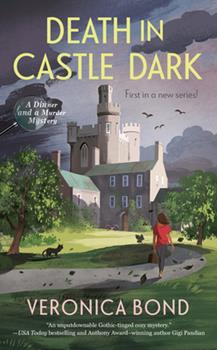
After the success of the Writer's Apprentice novels, I wanted to try something else in the cozy-Gothic vein. Soon enough I had dreamed up Castle Dark, the unlikely castle set in the middle of a rural Illinois suburb. I didn't want to have to feign knowledge of some European setting, so I brought the castle and characters to a setting I know well.


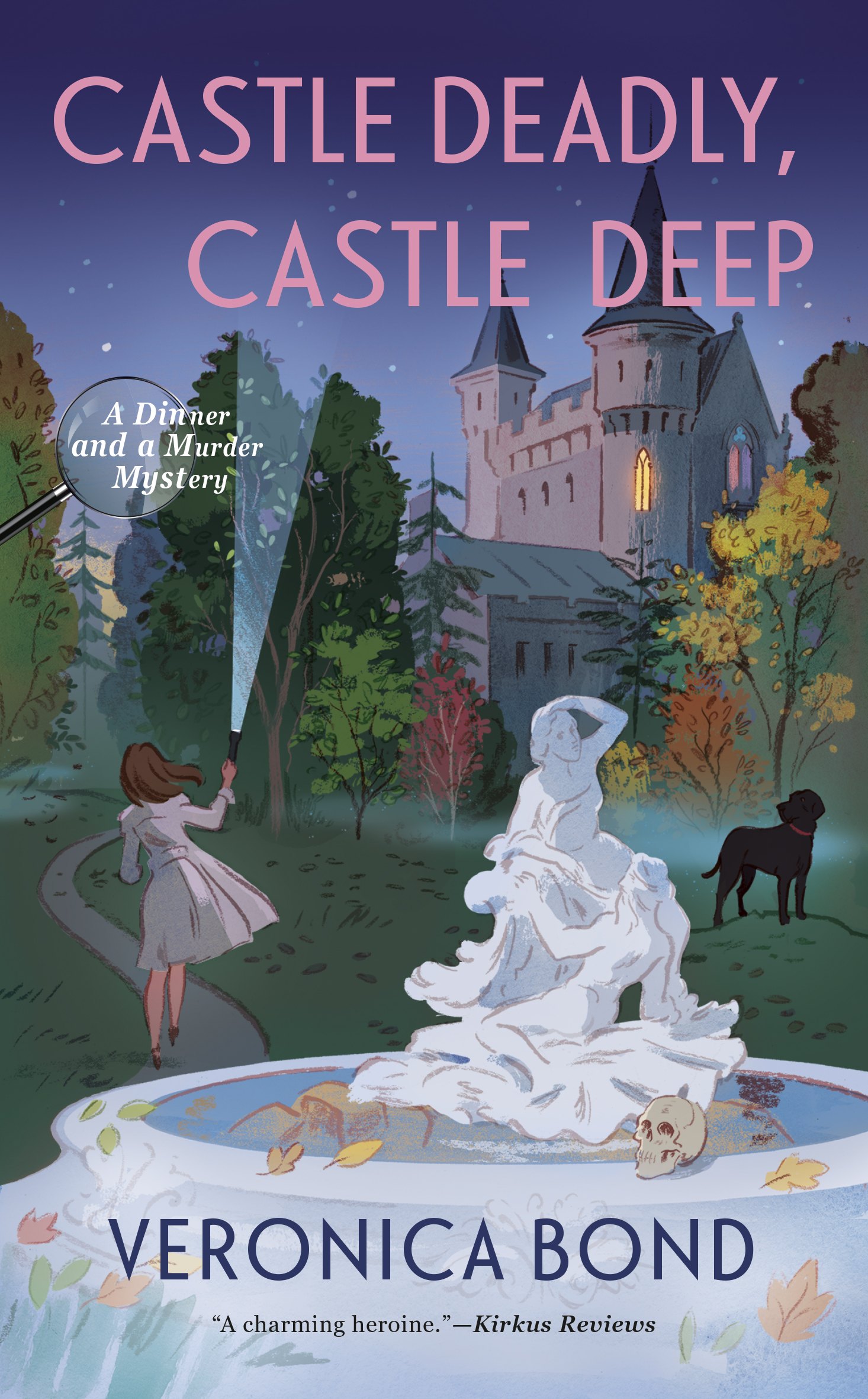
Under the name Veronica Bond, I have written two Castle Dark mysteries: Death in Castle Dark, and Castle Deadly, Castle Deep. The latter will hit bookstores on July 5. I've explored some of the Gothic tropes in a fun way, not delving into actual Gothic horror, but keeping some suspense in the halls of Derek Corby's castle. The series follows the exploits of a theatrical troupe that performs murder mystery scenarios for paying guests. Sometimes life imitates art . . . .


The castle dog, Hamlet, is very much based on my own dog, Digby, who is large and black and potentially intimidating to strangers, but who acts like a gentle puppy around us. 

You can meet him and a whole cast of fun characters in the Castle Dark "Murder and a Mystery" series.

Friday, December 24, 2021

Reflecting on a Year of Blindness

 In November of 2020 I began to lose vision in my left eye. It was gradual, expanding outward from a general grayness. I went to one doctor, who sent me to a specialist, who told me that I either had something very scary and life-threatening, or something less severe. She sent me for a blood test to rule out the super scary disease, and it was determined I did not have that. Instead, I had NAAION--or Non arteritic anterior ischemic optic neuropathy. It was fairly rare, no one knew what caused it exactly, and there was no cure. Oh, and the vision loss was permanent. I was also told there was a "slight chance" that within ten years it might happen in the companion eye.

In December of 2020, I began to lose vision in my right eye. This time a third doctor sent me straight to the emergency room, after which I was admitted to the hospital and stayed for the next four days. I was given intravenous steroids to try to arrest the vision loss, and perhaps return some of it. Alas, I think the treatment came too late. The vision did not return in either eye. I was told by a fourth docotr, a top Chicago neuro-opthamologist, that my central vision was gone, but that  I had "Pretty good" peripheral vision. "But you are legally blind," he told me cheerfully. I suppose he was used to delivering news like that. It was brand new for me.

For a year I've been adapting to legal blindness. I can no longer drive, which means no quick errands or trips to the store. I'm reluctant to walk alone, although I did just receive a walking cane from the Chicago Lighthouse that will help me to anticipate bumps and holes in the sidewalk. I bought an i-phone so that I could use the voice software which will read me my e-mail and messages. I bought dark markers and a giant pad so that I can make lists to organize my thoughts. Ironically, I can still write perfectly, but I can't read what I write. I can't read at all, and so I've discovered audiobooks. When I prepare to teach, I either have to listen to texts on audio or have someone read the material to me so that I can review it before class. This works well, but I do miss being able to make specific textual references, to point to a specific line that I've annotated for a particular reason. Worst of all, I cannot see faces. Not those of my family, my friends, my students. I cannot see my own reflection in the mirror.

There is a certain existential horror in being cut off from eye contact--perhaps our most essential way of connecting to other people. I miss that the most, I suppose. I also miss the autonomy that vision brings. I've sacrificed a fair amount of independence simply because I have to ask for help with so many things. Depending on others means I can't always set my own agenda, so my agency within situations is sometimes limited.

As a teacher and a writer, I find it almost unbelievable that this painless, silent condition would remove the very things I need most: the ability to read and connect. I have spent a year finding ways to adapt to my new situation, and, for the most part, I've been successful.

I should mention that there have been positives within this tough situation. I find that I listen more, and better, and that people appreciate that skill. The audiobooks I now listen to are a constant delight; I feel like a child again, listening to stories. I have been able, so far, to keep my teaching job with the aid of a T.A., (who happens to be my son, the perfect classroom companion)/; I find that I can still teach effectively and well, and I still find my job rewarding. Thanks to my high school typing teacher, I can type without being able to see the keyboard, so my writing career can continue. I am still surrounded by humor in the form of my husband and sons, and I laugh often. I worked with an occupational therapist who taught me many life hacks to help negotiate a blurry world: rubber band around the shampoo bottle, raised stickers on microwave and stove buttons, large lined pads and dark markers for writing. Neighbors and friends dropped off food, gifts, chocolates, gift cards, in a river of compassion that still warms my heart. People offered to read my work and help with editing, so I can still write with their help.

What I cannot do, unfortunately, is see the manuscript for editing myself . I have always prided myself on turning out clean documents and finding every little error with my eagle eye. Now I must ask others to edit for me, but I don't have the luxury of that final edit, where I can sign off on my own work. I regret this, and the fact that readers have already noticed some typos in my latest book.

The fact that other people are willing to help me, though, is most gratifying. I am finding some abilities that I did not know I possessed. For example, when I used to have to speak in public, I would compose a speech beforehand and read it at the podium. Now, without that possibility, I have to commit to a much more personal speech, memorizing the components in advance and then speaking extemporaneously. I have done this several times now, though I never would have done it before.

There is no denying that I would like to have my vision restored, but I am handling life just fine without it. Ultimately, in losing something, I find myself grateful for what I still have. Four others sense, some vision that can be enhanced with magnifying goggles so that I can type a post like this. It's like wearing the Hubble Telescope on my face, and it tires my eyes quickly, but hey--thank goodness for technology!

After a year of blindness, I am hopeful for new innovations, grateful for many blessings, and eager for a new year of writing and teaching. Life is good, my family and friends are healthy, I have three cat companions and a very loving Labrador, and sound software on my beloved laptop.  :)

So it's a happy holiday season, and I hope that you are happy as well, full of plans for a new year and full of ideas for books to read. 

Merry Christmas/Happy Holidays to one and all! May your days be merry and bright.


Monday, June 15, 2020

Join the Cozy Chat


Read, Socks, Coffee, Morning, Woman, Lifestyle, Relax

Join host Angela Maria Hart and me for a cozy chat Tuesday, June 16, on her YouTube Channel, Books Are My Hart. We'll chat about books, writing, and my various series for Berkley/Penguin.

The link is here.


Sunday, March 22, 2020

A Beautiful Fragment of Memory

Night View, Landscape, Lighting, Republic Of Korea


The amazing little intersections of life.

Way back when I was about four or five years old, my parents took us kids to the house of my godfather, a man I've only met a handful of times in my life. Back then he was still married to his first wife, whose face I cannot picture and whose name I cannot remember. However, at one point in the evening she pulled me into her lap and started singing a song to me that I had never heard: "Julie, Julie, Julie, do you love me?"

Fast forward about forty-five years. I was driving to work, listening to Oldies radio, and I heard that song, which it turns out was sung by Bobby Sherman. The years fell away, and I remembered that moment, sitting in the lap of a stranger who sang softly in my ear.

I don't know her name and can't see her face, but I remember her, thanks to a melody and a kind gesture.

Who knows how many people we influence in tiny ways? Who knows how many things we do will go into someone's permanent memory?

Saturday, December 28, 2019

A Decade's Worth of Books, and the Stories that Stayed


Pocket Watch, Time Of, Sand, Time, Clock, Clock Face
Best of the Decade
Ten Mysteries From the Last Decade That Stayed With Me
Julia Buckley

The Stieg Larsson Series (Book 1, American printing, 2010). 

      The Girl With The Dragon Tattoo had tough subject matter, but Larsson was a storyteller and he lured me in to this series with interesting characters and a plot which gave a strong woman a chance for both revenge and rebirth. I read the entire trilogy, but have not yet discovered the additional books written by David Lagercrantz (I might have to re-read the original series first).

The Crossing Places (2010). 

This moody and wonderful mystery by Ellie Griffiths is one of the most entertaining books I’ve read in the last decade. Ruth Galloway is an archeologist who lives alone in the gloomy Saltmarsh, and of course that’s where a body is discovered, and the police need her help to determine whether it’s an archeological find—or a recent murder.

Two Girls Down (2018) by Luisa Luna. 

This taut thriller about the disappearance of two little girls is memorable for many reasons, but what knocked me out was the wonderful narration by a kick-ass heroine named Alice Vega.

     The Trouble With Goats and Sheep (2016) by Joanna Cannon. 

      Truly some of the best writing I have ever read, and a powerful story that is part mystery, part morality tale, part coming of age novel. In a small English town in 1976, two little girls decide they must find out what happened to a woman on their block who has simply disappeared.

      Ordinary Grace (2016) by William Kent Krueger. 

      Krueger has many fans because of his lyrical, insightful mysteries. While he’s known for his wonderful Cork O’Connor mysteries set in Minnesota, this one is a stand-alone murder mystery with powerful themes that lift it into the realm of the literary.

     The Mystery of Mercy Close (2014) Marion Keyes. 
    
     This book had me in stitches on one page and close to tears on the next. Helen Walsh is a
     private investigator in need of business and an ex-husband with a missing persons case, and 
     those are only two problems in her very complicated life.

        Far Cry (2009) John Harvey. 
     
      This one’s not officially in the last decade, but I still think about the story of a missing girl, and the terrible pain her parents went through as the police worked to find her. Harvey’s writing is both lyrical and heart-wrenching.

      Rainbirds (2018) Clarissa Goenawan. 

      This book was a pleasant surprise--spare and lyrical prose in what seemed part Japanese novel, part mystery, part poetry.


     The Widows of Malabar Hill (2019) Sujata Massey. 
    
      Set in 1920s Bombay, this mysery was culturally rich and compelling.

     The Longmire Series, by Craig Johnson. (Book One: The Cold Dish, 2006. Most recent title, Land of Wolves). 

      I have read just about all of the Longmire books, and Johnson’s writing, both down-to-earth and literary at the same time, and ever-compelling, is always worth the read.

Thursday, April 25, 2019

A ME TOO Fiction Anthology

I'm proud to have a story in Liz Zelvin's upcoming anthology, ME TOO SHORT STORIES: An Anthology. The volume has gotten some great early press. You can click the link to check out the various authors in the book.

My story is called "Subterfuge," and it focuses on an eighteen-year-old girl in a dead-end town.

Friday, January 18, 2019

Suspense Author Louisa Luna on Her Kick-ass Female Investigator, Her Nail-Biter Plot, and Her Dream Writer's Retreat


Louisa Luna is the author of Brave New Girl and Crooked. She lives in New York City. Her new mystery, Two Girls Down, is available now; Publishers Weekly gave it a starred review, saying, "The brisk plot combines psychological suspense with solid action, while providing a realistic look at a family under siege, as it builds to a shocking finale."The story line teams a tough former bounty hunter with a disgraced former cop, and they work well together, both in the novel and with readers.


Louisa, thanks for visiting the blog. First and foremost, I’m sure readers want to know—is Two Girls Down a stand-alone, or will readers see Vega and Cap again? They both seemed to have secrets that could emerge in later books.                                                                                            

Oh, they’ll both be back. I’m happy to say the sequel is done – it’s called The Janes, and it will be out in about a year, published by Doubleday. There will also definitely be at least one more book after that. 

Alice Vega was a paradox—she broke rules, but she did it for the right reasons. I would love to have her fighting on my behalf. Did you have anyone, or any particular concept, in mind when you created her?

When I started writing, I just knew I wanted a tough woman protagonist. Salander from Dragon Tattoo was an influence but I wanted mine to be a little older and well-established in her career path. 

The challenge was to make her realistic – I wanted her to take no shit and do anything to get the job done, and I wanted her to be the smartest person in the room. And I wanted it to be believable that she could fight anyone at any time. All the research I did about bounty hunters (Vega’s former job) indicated that there are very few women in that line of work, and the women who make that their livelihoods are physically built for the job – tall and burly and able to take a bail jumper down through hand-to-hand combat. I wanted to build Vega average-size, but very strong but I knew in order to sell it on the page, she would have to use every other tool at her disposal as well – namely words and weapons. That informed a lot of her character along with her ability to read people and figure out what they need the most.   

The mystery has a terrible reality at its center—the endless narrative of missing girls. Did you do extensive research about abductions of women and girls in America? If so, I imagine it was depressing.

I pulled a lot from my own imagination to begin with. But then I did a lot of reading about missing persons and children, both girls and boys, which were all harrowing, deeply sad and disturbing stories. The grief that the parents and families of missing persons/children feel is just bottomless and never goes away. The three books on the topic that stand out in my memory are Bringing Adam Home by Les Standiford and Joe Matthews, The Last Place You’d Look by Carole Moore and People Who Eat Darkness by Richard Lloyd Parry. They are excellent reads, but tough subject matter.

After immersing yourself in this content for so long, what is your response to the recent and unexpected news that Jayme Closs has been found alive?

I would not call myself any kind of an expert on the topic, but this did seem like an unusual case because such a small percentage of abducted kids are abducted by strangers, as I recall. And even more unusual that the abductee survives, I would think.

But honestly I think I’m coming at it the way most people are, which is to say thrilled and happy that she is alive and astonished by her bravery. She has already beaten incredible odds.

I hope she can get to the other side of the trauma she’s been through; I saw that picture of her with her aunt and her dog and read her aunt’s statement – she has a lot of people who love her and who are pulling for her, which is all you can ask for in a situation like that.

One of the things I love about Alice Vega is that she simply refuses to be intimidated. Is this something she had to cultivate, or is it innate to her character?

I think the key to Vega is that she has no fear of pain or death. Once you take that away, there’s a great deal of freedom because she literally has nothing to lose. She’s also a pretty economical character, and I don’t mean in the monetary sense; I mean she only deals in what is useful to her.  I think she has found that fear is not useful in her life and work so she excised it at some point. Of course she is a human so she’ll still experience fear and guilt and love but she’ll do her best to stop it if it’s not serving her in some way.

I appreciated the fact that in creating your various law enforcement officials, who faced some internal conflicts, you stayed away from clichés and stereotypes and let the readers see some good in every one of them. Was this a conscious decision?

Absolutely. I find character clichés so lazy, and I get frustrated when I’m reading a book or watching a show/movie, and there’s a c*ckblocking FBI agent or an-impulsive-yet-talented rookie or a bad girl with a heart of gold. It’s not that these people can’t or don’t exist; I just always want them to be full real characters. That’s what I tried to do with all the cops and Feds, give them faces, names, quirks, bad sides, good sides. 

Also I have a good friend who is a cop who advised me a lot on procedural stuff, and from his stories on the job, it was very clear that law enforcement is like other workplaces in that some people are great and trying to do the right thing and some people are jerks and absolutely not trying to do the right thing.

I am assuming you are a mom based on the way you wrote the character of Jamie Brandt, and for this reason I am guessing her character was the hardest to write. Was it rather terrifying to imagine how it would feel to have your child abducted, almost under your very nose?

I am a mom! When I had my daughter, I felt like I suddenly understood something beautiful and terrifying about life. I started writing the book when she was two, and the plot kick-off was pretty much my deepest fears laid out on the page, so I suppose it was therapeutic in a way. 
 
There were times when we’d be at the playground or somewhere, and I’d be chatting with another mom or looking at my phone and then I’d glance up and not see her for thirty seconds, and well, there it is, that’s the fear, and every parent has felt it.

As for Jamie, I just tried to get inside her head and walk through those moments. I wanted them to feel excruciatingly real. 

Your dialogue was a pleasure to read. It was sophisticated, immersing me in the story, but it was also an opportunity to insert much-needed levity into a grim tale. I especially love the dialogues between Cap and his daughter, but also some that Cap had with his former colleagues. Is writing dialogue something that comes easily to you?

It feels that way. I love dialogue because it can do so much in such a small space. I think I also find out who my people are through dialogue more than prose. I knew Cap was going to have a teenage daughter who was sort of thoughtful but I didn’t know who Nell was until she started talking. Now it’s like she could have her own spin-off.

As for Cap and his buddies, again, I tried to work against cop clichés and layer shop-talk with humor and familiarity. But dialogue definitely crystallized these characters for me – Junior, Em, Traynor – all of their images sharpened up through the dialogue.

What got you started writing in this genre?

I’ve always loved mysteries/thrillers/noir. When I was in my twenties I was lucky enough to publish three books in a row. The third one, published in 2004, was my crack at a modern noir, and it was not particularly successful (narratively or commercially-speaking), but I was just starting to play around with the format.

So I read a lot between the time I finished that one and the time I started 2GD, and for some reason, I thought I could pull off writing a suspense novel. I didn’t know the ending when I started, but I think one of the things the most successful mysteries have in common is atmosphere, tone. And I thought if I could get that along with good characters, I’d be halfway home and could figure out the plot later.
Are there any particular authors that inspire you, in the mystery genre or elsewhere?

Oh, so many. I love a lot of authors are that can’t be genre-ized, or that create new genres, or are just really good at what they do. And as you see, they are all over the map. Some are: George Saunders, Rachel Kushner, Donald Ray Pollock, Carmen Maria Machado, Anna Quindlen, Lee Child, Mo Hayder, Donna Tartt, Elizabeth Strout.

What are you reading now?

As I wrote above, I recently finished the sequel which had an intensely complicated plot, and after that, I just needed to cleanse my brain of fiction so I read a great non-fiction book on a topic about which I knew absolutely nothing: What The Eye Hears: A History of Tap Dancing by Brian Seibert.  It is fantastic and totally accessible and beautifully-written. Now I’m a little obsessed with tap dancing.

Also I read a bunch of short stories but there’s one I can’t stop thinking about: “Two Lasagnas” by Elisa Albert in Tin House magazine. Talk about tone. I was sad when it was over. I would have been up for reading a Knausgaard-length autobiography in that character’s voice.

If you could go to a beautiful writer’s retreat anywhere in the world, where would you go?

Bolinas, California. My parents lived there for a while while I was in college and in my twenties, and something about the ocean and the beach and the fog just makes me want to slow down and let the ideas come in.

Where can readers found out more about you and your books?

Someday I’ll have a Twitter and an IG, but that day is not today.

Thanks so much, Louisa! I look forward to THE JANES.


Thursday, November 15, 2018

Feminism Can Be Funny

Penguin/Plume was kind enough to send me a copy of New Erotica For Feminists, a funny little book that looks at popular culture, dating, parenting, literature, and history through a distinctly feminist (and satirical) lens. Penned by four authors (Caitlin Kunkel, Brooke Preston, Fiona Taylor, and Carrie Witmer), this book has something for every reader who wants a good laugh, but the scenarios imagined within also give pause--why shouldn't a man offer a woman interesting conversation instead of a sexual proposition? Why DO we as readers tend to demonize Jordan Baker simply because we see her through the eyes of Nick Carraway?

My favorite passage was a re-imagining of the dialogue between Paris and Helen of Sparta as he prepares to whisk her off to Troy.

Helen tries to explain why this would be a bad decision, reminding him of some historical context around her beauty and things it has made men do, and the problems he would engender by angering Agamemnon, King of Mycenae:

Helen: How do you not know this? It's like you haven't even read Herodotus. You really need to brush up on the geopolitical history of this volatile region, tiger.
Paris: But you're so pretty!
Helen: (sigh) I wish I'd been born a centaur. 

A fun little book, small enough to fit in a Christmas stocking, weighty enough to engender many fine discussions, and funny enough to make you laugh out loud
.
 

Friday, October 19, 2018

The Joy of Talking About Books


“Nothing bonds two people so well as loving the same books.”

--Lena London, A Dark and Stormy Murder

              I am a member of two informal book clubs. One is a four-times-yearly gathering of interested faculty at the school where I teach. I am the unofficial “leader” of the club because I always come with about 30 typed questions that I hope will generate interesting discussions. These aren’t downloaded from book club sites; I always write my own because that is more authentic to my reading experience, and—well—I’m a bit obsessive.
              The group has enjoyed many wonderful conversations, and in two cases we Skyped with the authors themselves and directed our questions to them. Those were wonderful experiences that allowed us to take our questions about text straight to the creator, the generator of that text for some deeper insight.
              In every one of our meetings, I find myself getting to a point at which my heart beats faster, my face grows hot, and I become sort of enraptured by the way that literature can lift us to higher understanding. We learn things, discover things, TOGETHER—in a way that only this type of gathering can achieve.
              And so I would conclude that for the same reason I love to discuss literature with my students (who are themselves amazing, insightful observers of human nature), I love to discuss a good book with my book group.
              My other book group is a recent creation, born of an e-mail that I sent to people on my block. It said, “Is anyone interested in starting a block book group? Not the kind where people just use a book as an excuse to drink wine, but the kind where we actually read and discuss a book?”
              To my great pleasure, many people responded. I have nothing against wine—my husband sells it for a living—but when I have a book gathering, I want us to focus on words, on chapters, on thematic meaning. And many other people wanted to do that, too!  Our first meeting was a gathering of five women (a few more couldn’t make it). Our second had only four people (again, schedules were a problem), but our third looks like it might be a very large gathering because word has spread—we met to talk about books, and it was fun!
              I don’t always feel as if I have time in my schedule to prepare for book group. But when I read the book and then meet with my book friends, I am always glad that I made that time.
              If only more people knew how much joy, how much deep satisfaction was at their fingertips at any given time in the form of a good book, and how even more wonderful that experience can be when enriched by the insights of other people who have studied the same text.
              This Thanksgiving, I’ll be grateful for many things, including (as ever) books, the people who write them, and the people who read them, and the powerful culture of learning, sharing, and insight we can build together.

Thursday, April 05, 2018

An Enhanced Reading Experience: The Annotated Big Sleep

I am thrilled to have received an advanced copy of THE ANNOTATED BIG SLEEP from Vintage/Black Lizard Books. Raymond Chandler died in 1959, six years before I was born, but I always feel connected to him when I read his mysteries. His words effect that special intimacy with a reader that only the best writers can achieve; in fact, his books are so alive with wit and intelligence and satire that a reader feels almost collaborative when encountering Chandler--reading is not a passive event, but a conversation.

As the critical notes (written by Owen Hill, Pamela Jackson, and Anthony Rizzuto) make clear, Chandler was more than a mystery writer. His work was a commentary about a pre-and-post-war world that seemed to have been consumed by a general corruption, and his words contained such unblinking honesty that they can apply just as well to the depravity of the current era.

The annotated version contains a foreword by Jonathan Lethem, and an introduction by the three annotators, who suggest that "If Superman or John Wayne is the Zeus of American myth, and Marilyn Monroe is Aphrodite, then Marlowe is Prometheus: the noble outsider, sacrificing and enduring for a code he alone upholds." Perhaps this is the biggest part of Marlowe's appeal for a world that had been battered by war and which descended into an existential abyss.

One of my favorite details so far is that, in exploring an existential view of the world, Chandler achieved such spare and impressive prose that one might assume he had been influenced by the French existentialists--but in fact the reverse is true. "Albert Camus had pointed to American detective writers as a prime influence on his portrayal of the quintessential existential outsider, "L'Etranger," in 1942" (107).

Marlowe, too, is an outsider. Readers generally love The Other for the very fact that the societies in question have cast him out. We love the literary orphan (Oliver Twister, Harry Potter), the fictional dream-seeker (Gatsby, Don Quixote, Lily Bart), the rebel in an oppressive world (Hester Prynne, Edna Pontellier, Huck Finn). But Philip Marlowe stands alone, as the man who was forced to create a law unto himself, because he had a vague memory of justice that shaped his understanding of rightness in a world gone awry.

I will savor this book, first as a chance to re-read THE BIG SLEEP, and secondly for the rich textual notes that will deepen my understanding of the man, the work, and the time period.

(According to Amazon, THE ANNOTATED BIG SLEEP can be pre-ordered now).


Thursday, March 08, 2018

French Thriller Writer Franck Thilliez Chats About Sharks, Subliminal Messages and Syndrome E


Since I was just re-reading SYNDROME E, I thought I'd share this interview from 2013. 

Franck Thilliez's new novel, SYNDROME E, is his first book available in an American translation. The movie rights have been sold to Paintbrush Films.

Franck, thanks so much for discussing your book with me.

This novel introduced many themes: neuroscience, police work, schizophrenia, parent-child relationships, a computer-oriented world, violent video games, film technology, and subliminal suggestion, to name a few.  Do you start a novel knowing all the themes you would like to discuss, or does your research and writing lead you to more and more complicated plots?

Yes, I know, in a general way, the main topics I’ll talk about. Concerning Syndrome E, I wanted to talk about all themes concerning pictures and the impact they have on our brain. So, it concerned movies, video games, subliminal pictures, brain studies… But you’re right: the more I researched, the more I discovered plots that I could talk about, like neuromarketing or the way a movie is made. So, I naturally included them in my story.   

Lucie Hennebelle is a single mother of twins; she is also a career cop.  This sounds like an almost impossible combination. Do you think that cops, male and female, spend a lot of time feeling guilty about their family obligations?

I know a few cops and I often talk with them about their job. They are people really involved in their work, they like what they’re doing and are proud of it. When you work in the violent crime department, here in France, you can’t say: “I go to work at 8 am and come back home at 5 pm,” because it does not depend on you, but on murderers! If you work on a big case, it will take all your time, day and night, because, you know, the 2 or 3 first days after a crime is committed are the most important: you can’t lose a minute. So, you’ll not be at home, near your family, and your work will consume you. But, most of time, they do not feel guilty, because this job is a part of their life, as much important as their children. It’s not easy to be the wife of a cop (or the husband of a female cop), because, adding to that, this could be a dangerous job…

Someone in the novel suffers from hysterical blindness. I’d heard the term before, but had never really seen it applied to a situation.  How common is this condition?  How did you research it?

It’s an amazing condition. I heard about it when I talked with a psychiatrist. He said to me: “One day, I treated a woman who did not hear her husband when he talked to her. She heard her children, but she couldn’t hear him! This is what we call hysterical deafness. She’s not really deaf, but her brain makes her believe she is… ” It was amazing. By doing research, I discovered that there were all sorts of such hysterical problems: people thinking they’ve lost a leg or arm, people thinking they’re blind… All those conditions have a psychological explanation and can be solved.

Franck Sharko is a great name for a detective. Did he become Sharko because he is predatory to the bad guys?  Or did you have other reasons for giving him this name? (And is there a reason that you share a Christian name?)

Here, in France, most readers ask me : “Why did you call your detective Sharko ?” It’s great that you are American, because you immediately see that in Sharko, there is the English word “Shark."  Shark, because Franck Sharko never abandons, he’s really a hunter of killers and will work and work until he catches them! And for the first name, Franck, the same as mine: I just wanted “Franck Sharko” to sound hard, like German. Because he’s a hard guy!

One of the many facts that stood out for me was a film expert’s claim that François Mitterand attempted, in 1988, to subliminally influence voters by splicing his image into the credits of the evening news.  How did he achieve this?  Did he pay off a producer?

In France, the “Chanel 2” is a public channel, so it belongs to the French State. A president can choose the head of the channel, and he can decide to squelch publicity, … I don’t know how it really happened with François Mitterand, but because he was president since 1980 he had the power to put a subliminal image of himself on the evening news a few weeks before the election of 1988 to re-elect him! You must also know that during this period, there were no laws that forbade someone to use subliminal images in films or advertising…

Wow!  How worried should we be, in 2012, that we are being manipulated through the medium of film or things that we see on computer and television screens?

As I say in the book, we must protect our children, who are always watching violent pictures, in video games, on Internet or television. Most of them (under 7 years old) can’t distinguish reality from fiction. With the new technologies (phones, i-pads, Internet), times are changing; now our sons and daughters are growing up with violent pictures around them.

In extreme cases, we can perhaps see the consequence of this in the news: look what happened in Norway with Behring Breivik, look at the different massacres in schools over the last years, or the awful killing in the cinema during the broadcast of Batman, a few days ago. Some killers even try to post their acts on the Internet.

So, I don’t think we are manipulated, I just want to tell people: be careful of all those screen broadcasted pictures; they could be dangerous…

Are you an old film buff yourself?  Do you collect films?

When I was 15 years old, and for many years later, I used to watch all horror/thriller/suspense films that would be broadcast on TV! Sometimes, films were broadcast late in the night, and I remember going to bed and setting my alarm clock to wake me up just before the beginning of the film. It was also the period I was a member of a small video club, near my house, so I could rent of all the tapes I wanted. I used to collect video tapes, and then DVDs, but I sold most of them when I grew up, because I needed money! I always loved Hitchcock’s films, Dario Argento, Andrew Romero, David Cronenberg; and nowadays, David Fincher, Christopher Nolan or Ridley Scott are some of my favorite directors.

You must have loved Inception.  :)

Your description of Egypt, through Sharko’s eyes, is not flattering—it talked me out of ever visiting Egypt.  Have you travelled there?

Talking about the Egypt in tour guides with the Pyramids, Sphinx, nice places in Cairo was not interesting me. A crime novel must be more than a diversion; it must inform readers of the reality of our world. So, I wanted to show the country as it really is.  Most of people there are poor; they have difficulties surviving and they live in awful conditions. There are more than 8 shantytowns at the border of the Cairo, containing thousands and thousands of people. I say in the book that the police and government are corrupt. Revolution exploded in Egypt only a few months after the publication of Syndrome E in France, and I proves that I was not completely wrong…

And no, I never travelled there, but did a lot of research on this country, watching Egyptian films, reading books, talking by email with people there.

A small story : I tried to be in contact with the police there, just to ask single things, like “how are you clothed?” or “what are the grades in your police?,” but they never answered, they said top secret!

At one point Lily and Sharko feast on Kentucky Fried Chicken.  Is this American chain popular in France?

It’s starting to gain popularity, but it’s not as popular as McDonalds!

Ah, the ubiquitous McDonalds!  :)

There are many airplane journeys in the novel—Sharko finds them wearying, almost existential experiences—and yet they retain a certain glamour for the reader, linking the characters to far-flung locales.  What’s your attitude toward airplane travel?  Do you enjoy it?

In the last two years, I travelled a lot because of the publication of my books in many countries. I really like airplane travel. I love being in an airport, seeing people going abroad, and others coming back home. An airport is a particular place where you can touch the world. I read a lot during my travels, and sometimes I write. The most difficult is, of course, the jet lag, but it’s such a good thing to discover new countries and people.

Great point! On to Lucie Henebelle. Lucie is compared, by one character, to Jodie Foster.  Are you a Jodie Foster fan?  Did you see Lucie Henebelle as sort of similar to Foster’s Clarice Starling?  Or do you just like Foster’s combination of toughness and femininity?

I’m absolutely a fan of Jodie Foster! She’s a great actor and she would be perfect for Lucie, the main character of my book, if she were slightly younger. When I created Lucie a few years ago, I had in mind Jodie Foster as she was in The Silence of the Lambs, one of my favorite films.

Who are your literary influences? What are you reading now?

I started by reading Agatha Christie, Arthur Conan Doyle, and classical Anglo-Saxon crime novels. Then I had my period of Stephen King (and still do).  He’s a great writer. I spent night after night reading his books, trying to guess how he could frighten us so much. During my studies, I did not read a lot (but was watching films!). I started reading crime novels again 10 years ago. Nowadays, I read Dennis Lehane, Michael Connelly, but also books by John Steinbeck.

If I could make only one journey to France, where should I be sure to go?

Everywhere ! France is a beautiful country, with many cultures, great landscape, big towns but also very quaint villages, where the time has stood still. French food and wine are excellent; just spend time in a little restaurant of Paris or by the sea at Deauville or Cannes!

Sounds lovely! Thank you so much for a terrific read and for answering these questions.

You’re welcome. It was a pleasure.